
Click to increase the glare.
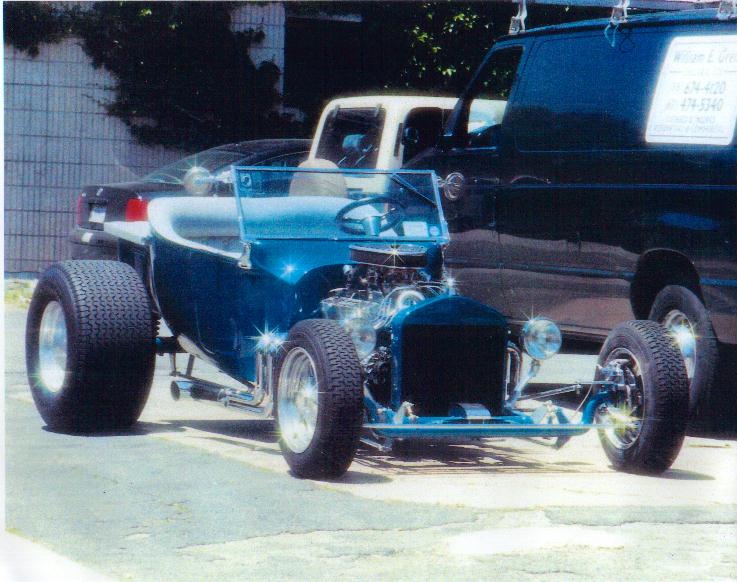
Mrs. F made the mistake of letting me get a cell phone with a camera this week.
Roland Sands has spent the last year peeling the skins off dirt bikes, reaching deep inside their body cavities. What he's found are the bikes' unlikely alter-egos.
The Super Single idea is so new that Wikipedia doesn't have an entry -- yet -- but when it does, it might go something like this: "A 450 Super Single is a single-cylinder 450-cc dirt bike that's been converted into an entry-level road racer. The frame, subframe, swing arm, motor and transmission are all stock, but the wheels, tires, suspension and bodywork have all been modified for on-track use and general skulduggery."


MESA, Ariz.- A pair of vans deployed by the state Department of Public Safety last week to electronically nab speeders are just the tip of the iceberg.
The DPS intends to install up to 120 fixed speed-enforcement cameras alongside rural highways and urban freeways in coming years, according to documents obtained by the East Valley Tribune newspaper under a public records request.
...
Better Plastic From Detroit?
DETROIT — One nice thing about being a journalist on the show floor during press days is that you run into people who have answers to your nagging questions.
Ever wonder why Toyota interiors are better than those from Ford or Chevrolet?
Ford, General Motors and Chrysler have had less money than their competitors to spend on car projects because they had to spend so much for pensions and health care, Mr. Cole said. And because interiors are the last part of a car to get commitments for investment, that is where corners are cut when the money runs out.
According to Mr. Cole, thanks to new contracts signed last fall with the union workers, G.M. will save $5,000 per car by 2010 and be on a level playing field with Toyota. And the first place consumers may notice a difference is better quality in future interiors.

General Motors says that the clear coat paint additive used on top of the carbon-fiber parts costs $60,000 a gallon, which breaks down to $900 a car. As for the rest of the car, Mr. Danahy said, “We tried not to go too crazy with the appearance.”
Second Law of Thermodynamics - Increased Entropy
The Second Law of Thermodynamics is commonly known as the Law of Increased Entropy. While quantity remains the same (First Law), the quality of matter/energy deteriorates gradually over time. How so? Usable energy is inevitably used for productivity, growth and repair. In the process, usable energy is converted into unusable energy. Thus, usable energy is irretrievably lost in the form of unusable energy.
The US automaker Ford on Thursday named Tata Motors of India as the preferred buyer of Ford's luxury Jaguar and Land Rover models.
"By May 1991 I was driving the pace car at the Indianapolis 500. Gen. Norman Schwarzkopf, just back from Iraq, was grand marshal and I drove him around the track once at 150 mph. Later, he found out I'd had a heart transplant. He said, 'I had a couple of close calls in Desert Storm but nothing like that ride.' "




"My thing with the green situation is: Even if you don't believe in global warming, don't you want to screw the oil company or gas company or utility company?"
His parts cleaners are eco-friendly -- one uses microbes to eat away grease and grime, the other employs ultrasonic cleaning bubbles. Instead of a gas-operated plasma cutter to saw parts out of sheet metal, a water jet does the job using sand. And refillable canisters of brake and carburetor cleaners take the place of throwaway aerosol cans.
Walking over to the power meter to confirm what he'd just read on the computer, he tapped the screen.
"Right now, I'm using all the power I want, and I'm generating more power than I'm using. Why would anybody get mad at you for that? To me, you want to be a good citizen. It's important to try and be a good citizen. And you can."
It's just expensive.

Two years ago, Goodwin got a rare chance to show off his tricks to some of the car industry's most prominent engineers. He tells me the story: He was driving a converted H2 to the SEMA show, the nation's biggest annual specialty automotive confab, and stopped en route at a Denver hotel. When he woke up in the morning, there were 20 people standing around his Hummer. Did I run over somebody? he wondered. As it turned out, they were engineers for GM, the Hummer's manufacturer. They noticed that Goodwin's H2 looked modified. "Does it have a diesel engine in it?"
"Yeah," he said.
"No way," they replied.
He opened the hood, "and they're just all in and out and around the valves and checking it out," he says. They asked to hear it run, sending a stab of fear through Goodwin. He'd filled it up with grease from a Chinese restaurant the day before and was worried that the cold morning might have solidified the fuel. But it started up on the first try and ran so quietly that at first they didn't believe it was really on. "When you start a diesel engine up on vegetable oil," Goodwin says, "you turn the key, and you hear nothing. Because of the lubricating power of the oil, it's just so smooth. Whisper quiet. And they're like, 'Is it running? Yeah, you can hear the fan going.'"
One engineer turned and said, "GM said this wouldn't work."
"Well," Goodwin replied, "here it is."
And the best part;
His latest project?
Goodwin leads me over to a red 2005 H3 Hummer that's up on jacks, its mechanicals removed. He aims to use the turbine to turn the Hummer into a tricked-out electric hybrid. Like most hybrids, it'll have two engines, including an electric motor. But in this case, the second will be the [jet] turbine, Goodwin's secret ingredient. Whenever the truck's juice runs low, the turbine will roar into action for a few seconds, powering a generator with such gusto that it'll recharge a set of "supercapacitor" batteries in seconds. This means the H3's electric motor will be able to perform awesome feats of acceleration and power over and over again, like a Prius on steroids. What's more, the turbine will burn biodiesel, a renewable fuel with much lower emissions than normal diesel; a hydrogen-injection system will then cut those low emissions in half. And when it's time to fill the tank, he'll be able to just pull up to the back of a diner and dump in its excess french-fry grease--as he does with his many other Hummers. Oh, yeah, he adds, the horsepower will double--from 300 to 600.
"Conservatively," Goodwin muses, scratching his chin, "it'll get 60 miles to the gallon. With 2,000 foot-pounds of torque. You'll be able to smoke the tires. And it's going to be superefficient."
He laughs. "Think about it: a 5,000-pound vehicle that gets 60 miles to the gallon and does zero to 60 in five seconds!"
And here's the punchline:
Goodwin's work proves that a counterattack is possible, and maybe easier than many of us imagined. If the dream is a big, badass ride that's also clean, well, he's there already. As he points out, his conversions consist almost entirely of taking stock GM parts and snapping them together in clever new ways. "They could do all this stuff if they wanted to," he tells me, slapping on a visor and hunching over an arc welder. "The technology has been there forever. They make 90% of the components I use."
...
Goodwin's feats of engineering have become gradually more visible over the past year. Last summer, Imperium Renewables contacted MTV's show Pimp My Ride about creating an Earth Day special in which Goodwin would convert a muscle car to run on biodiesel. The show chose a '65 Chevy Impala, and when the conversion was done, he'd doubled its mileage to 25 mpg and increased its pull from 250 to 800 horsepower. As a stunt, MTV drag-raced the Impala against a Lamborghini on California's Pomona Raceway. "The Impala blew the Lamborghini away," says Kevin Kluemper, the lead calibration engineer for GM's Allison transmission unit, who'd flown down to help with the conversion. [my em]
...
Think Love Ride, and images of Jay Leno and Harley-Davidson race to mind. But a nitro-fueled cacklefest? Flat-track racing? Stunt-rider pyramids?
The Love Ride is looking a little different in 2007. Now in its 24th year, Southern California's annual cruiser mecca is getting a face lift, with a change of venue and a new three-day adjunct called California Bike Week. Instead of the usual 35-mile pilgrimage to Castaic Lake, the 15,000 bikers expected to turn out for the world's largest one-day motorcycle fundraiser this Sunday will head east to the Pomona Fairplex.
That's the venue for two racing events that will take place earlier in the weekend - the All Harley Drag Racing Assn.'s Nitro Drag Races on Friday and Saturday and the Pacific Coast National Flat Track Series Debut Saturday night. It's also the site of weekend-long freestyle stunt shows, demo rides, a 150-vendor trade show and musical performances, including Gregg Allman, who headlines Sunday afternoon.
"We thought: If we can do the racing in Pomona and have the Love Ride at the same venue, it would really focus a lot of motorcycling activity into one venue and turn it all into a much bigger pie," said Oliver Shokouh, Love Ride founder and owner of Harley-Davidson/Buell of Glendale. "The Love Ride is not a Harley lifestyle event but a motorcycle event open to all motorcyclists of all brands. It's about anybody on two wheels."

The most celebrated Triumph racer of all time, the only machine ever to win five TT races in the Isle of Man in five consecutive years.
Slippery Sam was one of three similar models built for the 1970 Production TT, one of which, ridden by Malcolm Uphill, won the race at 97.71 mph. Tom Dickie was Sam's rider and, unused to Sam's ways, fumbled the Le Mans start and was last away. He rode to finish fourth.
The fastest lap was Alex George in 1975 at 102.82mph
The Slippery Sam nickname was coined during the 1970 Bol d'Or 24 Hour Race in France when a malfunctioning oil pump plastered the bike- and riders Tait and Jolly with oil.

Consider the Nissan PIVO2 on display here. It's an electric three-seat "city commute" vehicle (as opposed to a "Hollywood Freeway commute" vehicle) that is essentially a glass-and-metal bubble atop four small wheels.
Among the features: When you need to back up, rather than shifting into reverse, looking over your shoulder and inching into oncoming traffic, you wait while the cabin rotates 180 degrees and then drive straight ahead.
Hate to parallel park? Pull up next to that choice-but-tight space, rotate the cabin and all four wheels 90 degrees and proceed just as if you were pulling into your garage.
The PIVO2 also has a charming dashboard-mounted "robotic agent" that, according to Nissan's promotional brochure, "infers the driver's condition. It not only gives necessary information for the operation, but also speaks to you to cheer you up or to soothe you accordingly."
...
Right. Barrrrrrffff. No. First of all, I don't "turn my car on." I "fucking start the damn thing." Then I "spend the next half hour crawling behind dump trucks, garbage trucks, school buses, asswipes driving 15 mph below the speed limit" and/or "hitting every goddamn traffic light between here and there." Secondly, the only thing I ever want to do with my -- mmmm, hard! -- stick shift is rip it from whatever its bolted onto and use it to repeatedly pummel the head of the jerkoff ahead or behind me that's driving like a fucking moron. Thirdly, go fuck yourselves, you pretentious asstools.
Albany -- Acting New York State Commissioner of Taxation and Finance Barbara Billet Thursday announced the arrest of a Long Island car dealer on charges of tax fraud stemming from an investigation initiated by Suffolk County District Attorney Thomas Spota.
Salvatore Cioffi, 66, of 404 Landing Avenue, Smithtown, New York is the owner of Automart of LI Inc. located in Patchogue, a corporation engaged in the wholesale and retail sale of used automobiles. Cioffi was investigated for alleged underreporting of taxable sales and failure to remit sales tax collections.
...


Wally Parks, the hot-rodder and entrepreneur who curbed drag racing on city streets by steering drivers onto legal racing strips and founded the National Hot Rod Assn., has died. He was 94.
"Today is a sad day in the world of NHRA and the sport of drag racing," NHRA President Tom Compton said in a statement. "Words simply can't describe the immeasurable impact Wally has had on the sport he created and the millions of people's lives he touched along the way."


Millions of inventions pass quietly through the U.S. patent office each year. Patent No. 7,033,406 did, too, until energy insiders spotted six words in the filing that sounded like a death knell for the internal combustion engine.
An Austin-based startup called EEStor promised "technologies for replacement of electrochemical batteries," meaning a motorist could plug in a car for five minutes and drive 500 miles roundtrip between Dallas and Houston without gasoline.
The technology also could help invigorate the renewable-energy sector by providing efficient, lightning-fast storage for solar power, or, on a small scale, a flash-charge for cell phones and laptops.
Skeptics, though, fear the claims stretch the bounds of existing technology to the point of alchemy.
The result is an ultracapacitor, a battery-like device that stores and releases energy quickly.
Batteries rely on chemical reactions to store energy but can take hours to charge and release energy. The simplest capacitors found in computers and radios hold less energy but can charge or discharge instantly. Ultracapacitors take the best of both, stacking capacitors to increase capacity while maintaining the speed of simple capacitors.
Until EEStor produces a final product, Perry said he joins energy professionals and enthusiasts alike in waiting to see if the company can own up to its six-word promise and banish the battery to recycling bins around the world.
"I am skeptical but I'd be very happy to be proved wrong," Perry said.


